

Enterprise AI projects routinely clear their technical milestones: infrastructure is configured, models are integrated, dashboards go live, and launch dates are met. Yet across industries, organizations report that employee workflows remain largely unchanged weeks or months after go-live. McKinsey reports that research suggests roughly 70% of organizational transformations fail, meaning they do not achieve their goals, take too long, or fail to sustain their gains. AI rollouts tend to follow the same pattern. The technology performs as designed, but the people layer does not.
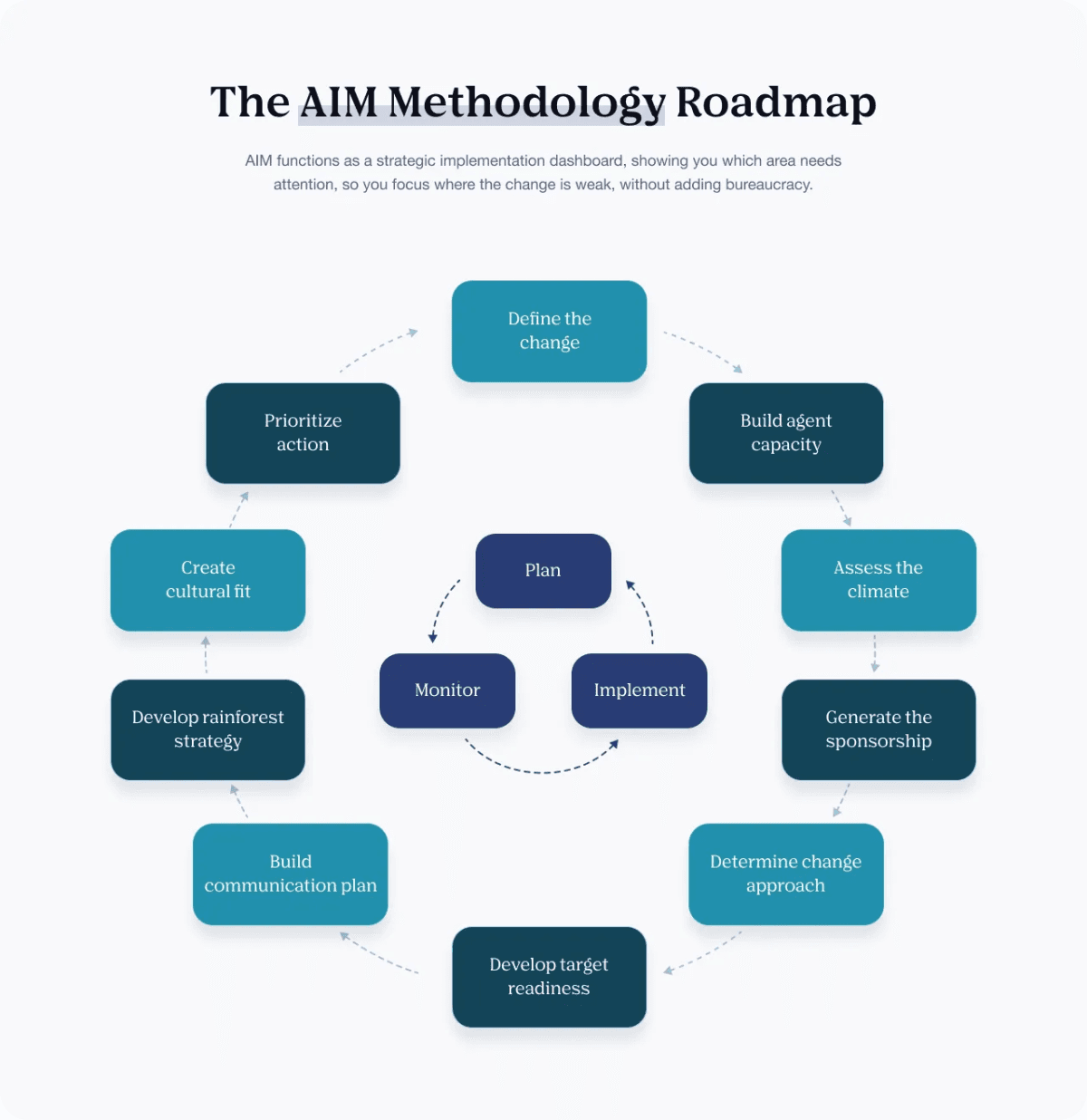
IMA Worldwide has positioned its Accelerating Implementation Methodology (AIM) as a structured response to this persistent problem. The firm draws a clear distinction between installation and implementation. Installation is the moment a system becomes operational. Implementation is the sustained period during which employees adopt new behaviors, abandon legacy habits, and integrate new tools into daily work. In most enterprise AI programs, significant investment is directed at the former while the latter receives limited structured support. That imbalance, according to IMA Worldwide, is the primary reason adoption stalls.
The AIM framework was developed by Don Harrison over more than 40 years of field research into why organizational initiatives succeed or fail. Rather than treating change as a communications exercise or a training event, AIM treats it as a system that must be actively managed, with defined roles, measurable reinforcement, and accountability structures built into the implementation plan from the outset. A central element relevant to AI adoption is the role of executive sponsorship. IMA Worldwide emphasizes that sponsorship is not a ceremonial function. Executives responsible for AI initiatives are expected to express commitment to the change in clear, consistent terms, model the new behaviors themselves, and reinforce adoption by adjusting systems, incentives, and consequences accordingly. IMA Worldwide refers to this as the Express, Model, Reinforce (EMR) ratio, a framework for evaluating whether leadership behavior is actually driving the adoption effort or simply endorsing it from a distance.
When the EMR ratio is out of balance, employees receive mixed signals. A leader may express support for an AI tool in a town hall while continuing to request outputs in formats that bypass it entirely. That inconsistency communicates more to employees than any formal message about AI adoption, and AIM identifies closing that gap as a leadership accountability issue, not a change communications issue.
IMA Worldwide's application of AIM to enterprise AI programs centers on building what the methodology calls a sponsorship cascade. Senior executives who own the strategic rationale for an AI initiative cannot delegate adoption responsibility entirely to project teams or IT departments. AIM requires that commitment be actively demonstrated and reinforced at each layer of the organization, from senior leadership through middle management to frontline employees whose daily behavior ultimately determines whether an AI system delivers measurable value. This structure matters particularly in AI deployments because the behavioral changes required are often more fundamental than those associated with earlier technology rollouts. Employees are not simply learning new software interfaces. They are being asked to change how they make decisions, how they verify information, and in some cases how they define their own professional contributions. Without active leadership reinforcement grounded in a methodology like AIM, those shifts rarely become durable.